BMI Calculator with GLP-1 Eligibility
Enter your height and weight to calculate your BMI and see if you may qualify for GLP-1 weight loss treatment.
Sources checked by FormBlends Editorial Research · Last reviewed 2026-11-19 · 10 sources
BMI and GLP-1 eligibility thresholds at a glance
- The calculator uses the standard US formula: pounds divided by inches squared, times 703. This gives the same number as kilograms divided by meters squared, the metric definition the CDC uses. The result is rounded to one decimal place.
- Two BMI numbers matter for GLP-1 weight management: 30 and 27. The FDA labels for Wegovy (semaglutide) and Zepbound (tirzepatide) cover adults with a BMI of 30 or more, or 27 or more with at least one weight related condition. The STEP 1 and SURMOUNT-1 trials enrolled people on the same rule.
- Between 25 and 27, the calculator shows Overweight but does not flag a screening match. A BMI of 25.0 to 26.9 is in the CDC overweight range but below both label thresholds, so the tool tells you a BMI of 27 or more with a related condition is the lower cutoff.
- From 27.0 to 29.9, the result depends on a health condition. The tool flags this band and names the conditions it checks for: type 2 diabetes, high blood pressure, high cholesterol or other lipid problems, and sleep apnea.
- BMI is a screening number, not a diagnosis. The CDC states that BMI does not measure body fat directly and does not separate fat from muscle and bone. Two people with the same BMI can carry very different amounts of fat.
- Some groups use lower cutoffs. A WHO expert panel found that in many Asian populations, health risk rises at lower BMI levels, and listed 23, 27.5, 32.5 and 37.5 as public health action points.
How the BMI calculator turns height and weight into a number
Body mass index is weight divided by height squared. In metric units that is kilograms divided by meters squared. In US units the calculator multiplies by 703 to convert pounds and inches into the same scale: BMI = weight in pounds ÷ (height in inches × height in inches) × 703.
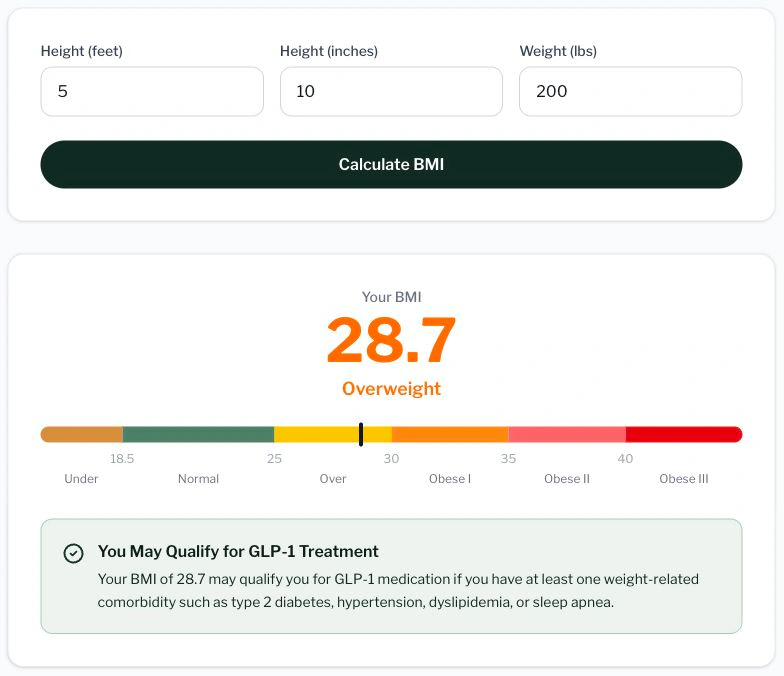
Worked example. Take a person who is 5 feet 10 inches and weighs 200 pounds. Height in inches is 70. Seventy squared is 4,900. Then 200 ÷ 4,900 = 0.0408, and 0.0408 × 703 = 28.7. The calculator shows a BMI of 28.7, in the Overweight band from 27 to 29.9. That band is where a weight related condition decides whether the BMI meets the label threshold.
Second example. A person who is 5 feet 4 inches (64 inches) and weighs 175 pounds: 64 squared is 4,096, 175 ÷ 4,096 = 0.0427, and 0.0427 × 703 = 30.0. That is the first BMI in Obese Class I, so the tool reports that it meets the BMI 30 or more screening threshold with no condition needed.
Third example. At 6 feet (72 inches) and 250 pounds, 72 squared is 5,184, 250 ÷ 5,184 × 703 = 33.9. At 5 feet 10 inches and 185 pounds, the result is 26.5. That 26.5 lands in the 25 to 26.9 band, so the tool does not flag a screening match.
The calculator accepts heights from 3 to 8 feet and weights from 50 to 800 pounds. It does not take age, sex, waist size or muscle mass into account. Those are the main reasons BMI can mislead for one person while still being useful across a population. Leaving the inches box empty makes the BMI calculator use zero inches, so enter 10 separately for a height of 5 feet 10 inches.
BMI categories and what this calculator tells you in each one
The CDC defines adult BMI categories for people 20 and older. The calculator follows those categories and adds one extra split at 27 because that is where GLP-1 weight management labels change their rule. The table shows each band, the CDC name, and what the tool reports. The colored bar under your result is drawn to scale from BMI 15 to 45, with band edges at 18.5, 25, 30, 35 and 40; a result below 15 or above 45 sits at the end of the bar.
Obesity class names come from the CDC page on adult BMI categories. Class 3 is also called severe obesity. The CDC notes that these categories are a screening tool and that a health care professional would look at other factors before drawing conclusions about health.
| BMI range | CDC category | What the calculator shows |
|---|---|---|
| Below 18.5 | Underweight | Underweight. No GLP-1 screening match. |
| 18.5 to 24.9 | Healthy weight | Normal Weight. No GLP-1 screening match. |
| 25.0 to 26.9 | Overweight | Overweight. Below the 27 threshold, so no screening match. |
| 27.0 to 29.9 | Overweight | Overweight. Flags that 27 or more with a weight related condition may meet the label rule. |
| 30.0 to 34.9 | Obesity, Class 1 | Obese Class I. Meets the BMI 30 or more screening threshold. |
| 35.0 to 39.9 | Obesity, Class 2 | Obese Class II. Meets the BMI 30 or more screening threshold. |
| 40.0 and above | Obesity, Class 3 (severe) | Obese Class III. Meets the BMI 30 or more screening threshold. |
Weight at each BMI cutoff by height
Most people want the reverse answer: at my height, what weight puts me at 25, 27 or 30? The table below runs the calculator formula backward. Weight in pounds = BMI × height in inches squared ÷ 703. Each figure is rounded to the nearest pound, so a weight one pound below the listed number may round to just under the cutoff.
Example of reading the table. At 5 feet 6 inches, a BMI of 27 starts at about 167 pounds and a BMI of 30 starts at about 186 pounds. So a person at that height who weighs 175 pounds has a BMI near 28.2, inside the band where a weight related condition matters.
| Height | BMI 18.5 | BMI 25 | BMI 27 | BMI 30 | BMI 35 | BMI 40 |
|---|---|---|---|---|---|---|
| 5'0" | 95 | 128 | 138 | 154 | 179 | 205 |
| 5'2" | 101 | 137 | 148 | 164 | 191 | 219 |
| 5'4" | 108 | 146 | 157 | 175 | 204 | 233 |
| 5'6" | 115 | 155 | 167 | 186 | 217 | 248 |
| 5'8" | 122 | 164 | 178 | 197 | 230 | 263 |
| 5'10" | 129 | 174 | 188 | 209 | 244 | 279 |
| 6'0" | 136 | 184 | 199 | 221 | 258 | 295 |
| 6'2" | 144 | 195 | 210 | 234 | 273 | 312 |
| 6'4" | 152 | 205 | 222 | 246 | 288 | 329 |
Why a BMI of 27 needs a weight related condition for GLP-1 weight management
The labels for the approved GLP-1 weight management medicines set two routes. A BMI of 30 or more qualifies on BMI alone. A BMI of 27 or more qualifies only with at least one weight related condition. Common examples in the labels and trials are high blood pressure, type 2 diabetes and abnormal blood lipids. The calculator names those, plus sleep apnea, in its message for the 27 to 29.9 band.
The trials behind those labels used the same rule. STEP 1 enrolled 1,961 adults without diabetes who had a BMI of 30 or more, or 27 or more with at least one weight related condition. SURMOUNT-1 used the same entry rule with 2,539 adults, and its participants had an average starting BMI of 38.0. So the trial results that people quote for semaglutide and tirzepatide come from people who met these cutoffs.
Compounded semaglutide and tirzepatide are not FDA approved. They are not the same product as Wegovy, Ozempic, Zepbound or Mounjaro, and the FDA has published its concerns about unapproved GLP-1 drugs used for weight loss. The BMI cutoffs on this page come from the approved labels and the trials. A licensed prescriber decides whether any prescription is appropriate for a given person.
- BMI 30.0 or more: meets the BMI threshold on its own.
- BMI 27.0 to 29.9: meets the BMI threshold only with a weight related condition.
- BMI below 27.0: below the BMI threshold used in the labels.
When BMI misreads body fat: muscle, age, waist size and ethnicity
BMI cannot tell fat from muscle. A muscular person can have a BMI over 27 with low body fat. An older adult who has lost muscle can have a BMI under 25 with a high share of fat. The CDC describes BMI as a screening measure for this reason.
Waist size adds information BMI misses. The NHLBI states that a waist over 35 inches for women or over 40 inches for men raises the risk of heart disease and type 2 diabetes in people who are overweight or have obesity. If your BMI is close to a cutoff, a waist measurement helps show where you carry weight. The FormBlends body composition tool estimates body fat from waist and neck measurements.
Ethnicity changes the risk picture too. A WHO expert consultation published in The Lancet in 2004 found that in Asian populations, the BMI at which health risk rises varies from 22 to 25, and high risk starts somewhere from 26 to 31. The panel kept the standard WHO cutoffs for international use but added 23, 27.5, 32.5 and 37.5 as extra action points. This calculator uses the standard cutoffs only.
BMI for children and teens is calculated the same way but read on age and sex percentiles. This tool is for adults. Pregnancy also makes BMI hard to read.
Questions people ask about the bmi calculator
What BMI do you need for GLP-1 weight loss medication?
The FDA labels for Wegovy and Zepbound cover adults with a BMI of 30 or more, or a BMI of 27 or more with at least one weight related condition such as high blood pressure, type 2 diabetes or high cholesterol. The STEP 1 and SURMOUNT-1 trials used the same entry rule. A prescriber looks at your full history, not BMI alone.
How do I calculate BMI by hand in pounds and inches?
Divide your weight in pounds by your height in inches squared, then multiply by 703. For 5 feet 10 inches (70 inches) and 200 pounds: 200 ÷ 4,900 × 703 = 28.7. That is the exact formula this calculator runs.
Is a BMI of 27 considered overweight or obese?
A BMI of 27 is in the CDC overweight range, which runs from 25 to just under 30. Obesity starts at 30. The number 27 matters because it is the lower BMI threshold in GLP-1 weight management labels when a weight related condition is present.
What weight is a BMI of 30 at my height?
Multiply 30 by your height in inches squared and divide by 703. At 5 feet 4 inches that is about 175 pounds, at 5 feet 10 inches about 209 pounds, and at 6 feet about 221 pounds. The table on this page lists nine heights.
Why does my BMI say overweight when I am muscular?
BMI only uses height and weight, so it counts muscle the same as fat. The CDC notes that BMI does not distinguish between fat, muscle and bone mass. A waist measurement or a body fat estimate gives a better read for very muscular people.
Do BMI cutoffs differ for Asian adults?
Yes, in some guidance. A WHO expert consultation found that health risk in many Asian populations rises at lower BMI values and suggested extra action points at 23, 27.5, 32.5 and 37.5. This calculator uses the standard cutoffs of 18.5, 25 and 30.
What are the BMI obesity classes?
The CDC splits obesity into three classes. Class 1 is a BMI of 30 to under 35, Class 2 is 35 to under 40, and Class 3, also called severe obesity, is 40 or higher. The calculator labels these Obese Class I, II and III.
I changed my weight. Why did my BMI result disappear?
Changing height or weight clears the previous result. Press Calculate BMI again to run the new numbers and redraw the gauge.
Sources
- CDC: Adult BMI Categories
- CDC: About Body Mass Index (BMI)
- NHLBI: Assessing Your Weight and Health Risk (waist circumference)
- WHO Expert Consultation. Appropriate body mass index for Asian populations. Lancet 2004
- DailyMed: Wegovy (semaglutide) prescribing information
- DailyMed: Zepbound (tirzepatide) prescribing information
- ClinicalTrials.gov: STEP 1, semaglutide 2.4 mg in adults with overweight or obesity (NCT03548935)
- ClinicalTrials.gov: SURMOUNT-1, tirzepatide in adults with obesity (NCT04184622)
- FDA: Concerns with unapproved GLP-1 drugs used for weight loss
- WHO: Obesity and overweight fact sheet
How this page was made
We read the calculator source code to confirm the exact formula (pounds ÷ inches squared × 703, rounded to one decimal) and the cutoffs it uses for each message, including the extra split at 27. Every worked example and every weight in the height table was computed with that same formula. Category names and boundaries were checked against the CDC adult BMI page, and the 27 and 30 thresholds against the Wegovy and Zepbound labels and the STEP 1 and SURMOUNT-1 trial records. The lower Asian action points come from the 2004 WHO expert consultation in The Lancet.
What this tool is and is not. This calculator does arithmetic on height and weight only. It does not diagnose obesity, does not check health conditions, and does not decide whether any medicine is right for you. FormBlends connects patients with licensed providers and pharmacies; it does not prescribe or dispense, and a licensed prescriber makes any treatment decision.
Body fat percentage calculator
Estimate body fat with the U.S. Navy tape method when BMI alone does not tell the full story.
Protein and calorie calculator
Turn your height, weight and activity into daily calorie and protein targets.
GLP-1 weight loss timeline
See how published trial averages line up with your goal weight.
GLP-1 journey planner
Use your height and weight in a plan that also brings together schedule, budget and nutrition.
Ready to Start Your Weight Loss Journey?
FormBlends offers compounded GLP-1 medications at a fraction of the brand-name cost, with physician oversight.
Explore GLP-1 OptionsRelated Articles
FormBlends for iPhone
Track progress over time
Log weight trends, doses, meals and private progress photos in the free FormBlends iPhone app.
Medical Disclaimer: This tool is for informational purposes only and does not constitute medical advice. BMI is a screening tool and does not directly measure body fat or health status. GLP-1 eligibility requires evaluation by a licensed healthcare provider. Always consult with a qualified medical professional before starting any medication or weight loss program.